


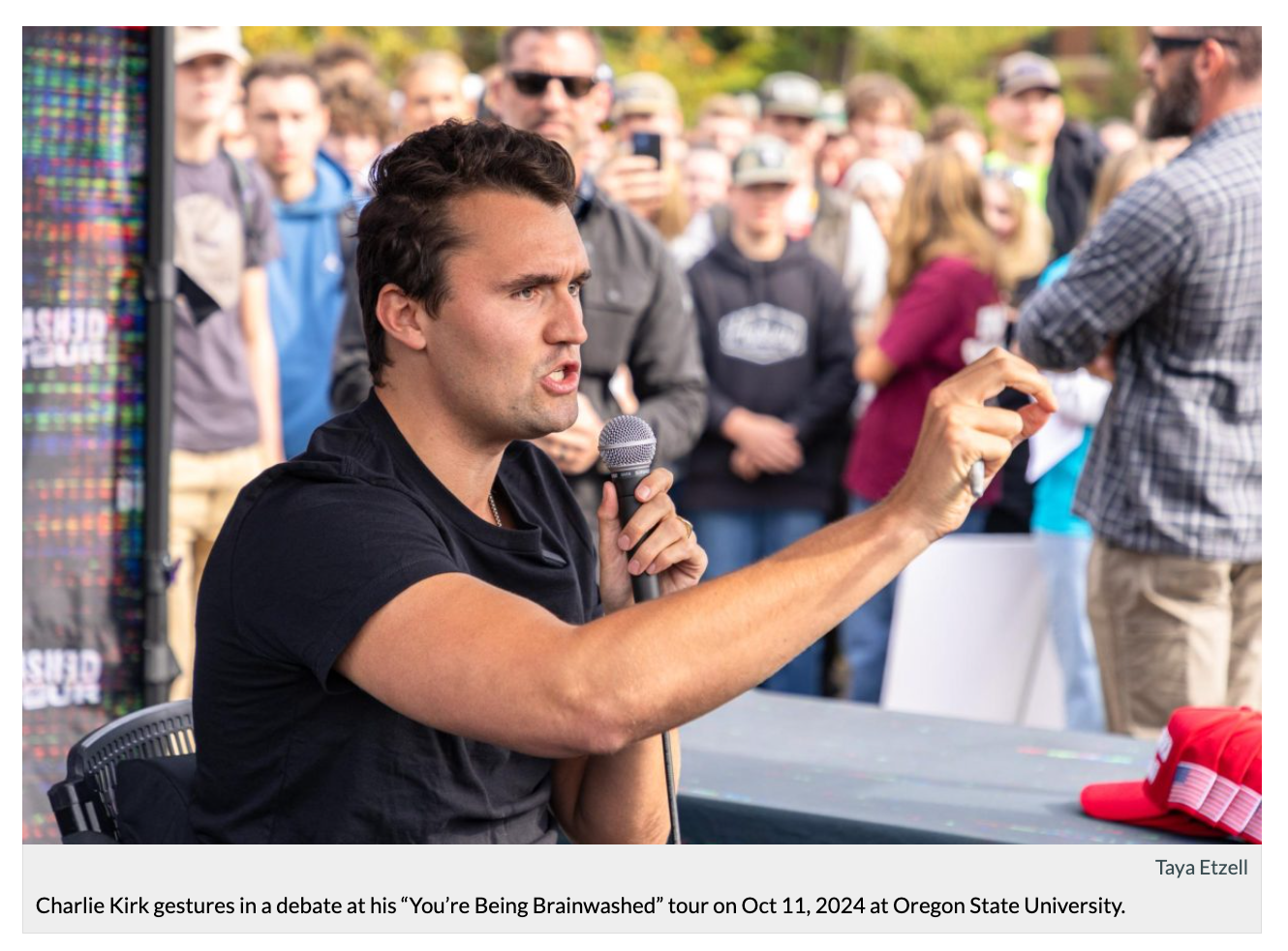
It’s been over a month since MAGA Influencer Charlie Kirk was killed. So I thought maybe I can add my thoughts regarding the mainstream news media’s troubling coverage of his death (specifically legacy/traditional media) without being swamped by goal post-moving snowflakes, mouth breathers, and bootlickers.
As most of us know, Charlie Kirk, far-right activist and founder of the organization Turning Point USA, was shot and killed by a lone sniper on September 10, 2025. He was speaking at an event on the Utah Valley University campus in Urem, Utah). Prior to Kirk’s death he had been described as a political activist, agitator, white supremacist, racist, cultural flamethrower, misogynist, eugenicist, etc. He had said many racist, demeaning, and inflammatory things about anyone who was not a white heterosexual male. (Note: Below this post are articles and videos that have compiled a list of Kirk’s quotes and commentary).
As expected, the Trump Administration’s response to the shooting – or to anything – was “let’s erase stuff that could make us look bad!” A day after Charlie Kirk’s death and when we learned more about the shooter (American white male, business owner dad, social worker mom, police chief uncle, alleged far right viewpoints), the Department of Justice deleted a June 2024 study showing that most domestic terror attacks come from the far right. To quote the article regarding the Administration’s censorship: “Critics say this erases key data and fuels partisan spin blaming the left for violence. Experts warn this move could escalate tensions.” Guess you can’t have the pesky truth around when you are all about alternative facts.
What should not have been expected is the news media doing their own version of cleaning, or whitewashing (pun sort of intended), of Charlie Kirk’s past in their coverage of his death.
Overall the U.S. news media’s coverage of Charlie Kirk’s murder/killing was embarrassing. The Columbia School of Journalism described some of the network coverage as follows: “Fox News held Kirk up as a martyr. CNN eulogized him, describing in anodyne terms his outsize impact on the American political consciousness and his reputation for initiating debates with his detractors.”
Heck, even the foreign press joined-in on the digital delousing of Kirk. The United Kingdom’s Daily Mail, Australia’s Sky News, and Canada’s The National Post respectively described Kirk as a “young hero of U.S. conservatives,” “an American hero,” and an “intellectual throwback to a more civilized time.” While the foreign press were waxing quixotic about Charlie Kirk, the EU Parliament begged to differ in regards to deifying Kirk even for a minute.
Some intrepid news analysts and journalists tried to tell viewers what Charlie Kirk really represented. MSNBC political analyst Matthew Dowd said the following about Kirk:
“He’s been one of the most divisive, especially divisive younger figures in this, who is constantly sort of pushing this sort of hate speech or sort of aimed at certain groups…And I always go back to, hateful thoughts lead to hateful words, which then lead to hateful actions. And I think that is the environment we are in. You can’t stop with these sort of awful thoughts you have and then saying these awful words and not expect awful actions to take place. And that’s the unfortunate environment we are in.”
Dowd received backlash in response to his above comments. He was forced to apologize for his statements, but MSNBC still fired him.
News sites, columnists, and pundits didn’t seem to have the bandwidth nor the skills to cover Kirk’s death *and* the other pertinent components regarding Kirk’s death such as 1) his divisive politics and alarming statements/beliefs; 2) why people were sad, uncaring or gleeful about his death; 3) the GOP’s hyperbolic response to Kirk’s killing vs. their silence in response to the June 14, 2025 shootings in Minnesota that killed a state representative and her spouse and wounded a state senator and his spouse (which has been described as a “politically-motivated assassination”); and 4) Utah’s gun laws (allows anyone 21 years of age or older to carry an open or concealed gun – no permit required) which one could conclude may have made it easier for the gunman to carryout his plan to kill Charlie Kirk.
While covering Kirk’s shooting and death, the U.S. mainstream media was very careful about not showing videos or images of Kirk’s shooting. But they didn’t take that same care when it came to being truthful about Kirk the person. In fact, they went out of their way to cover-up images of his death and what was publicly-known about Charlie Kirk and his controversial statements. If you weren’t onboard with the hagiography, then you were fired, kicked to the curb and forced to apologize, or your show was cancelled (albeit temporarily).
What’s oddly interesting is that the American news media reacted to Kirk’s killing as if he was on par politically and/or culturally with others who had met the same targeted fate (e.g., U.S. President Abraham Lincoln, Archduke Franz Ferdinand, anti-colonial activist Mahatma Gandhi, U.S. President John F. Kennedy, civil rights activist Dr. Martin Luther King, Jr., musician John Lennon) – he was not.
I wasn’t alone in my disgust regarding the media’s burnishing of Kirk after he had been shot and especially once his death had been confirmed. A Hollywood Reporter article discussed how “[t]he aftermath of the shooting exposed how little traditional journalists understand the platforms shaping online radicalization and real-world violence.” In Deadline, BBC News viewers complained that the news channel was “biased” against Kirk, but also said that the “controversial nature of [Kirk’s] opinions should have been scrutinized more closely” by the network. An Arizona Central columnist wrote that firing journalists for their allegedly anti-Kirk comments “doesn’t excuse [the media] lionizing a complex person and ignoring whatever controversies might have surrounded them. The truth is the truth, no matter how tragic the circumstances.”
Maybe the journalistic soft-pedaling was simply because reporters, anchors, and pundits didn’t want to be placed on leave, be investigated, or lose their job by actually doing their job. So much for the power of the Fourth Estate – though it’s power is not what it used to be. James B. Greenberg, in his Substack article “The Vanishing Watchdog: On the Decline of the Fourth Estate” describes the weakened state of journalism:
We have witnessed a long, slow shift from journalism as a civic institution to journalism as a market commodity. The consolidation of media into a few corporate hands has narrowed the range of narratives, prioritized profit over public service, and replaced investigative work with infotainment. Local news—once the eyes and ears of the community—has been gutted. Newsrooms have closed. Reporters have vanished. The spaces where citizens once learned to interpret the state and hold it accountable have been hollowed out…The Fourth Estate was never perfect, but it was a line of defense against the excesses of the state—and now, that line is broken in too many places.
How Charlie Kirk was killed was gruesome. But that doesn’t change the fact that Kirk definitely said, believed, and practiced a hateful, elitist, and uncaring ideology towards women, Black women, LGBTQ+, Black people and other Persons of Color, disabled persons, undocumented immigrants, the poor, the marginalized, senior citizens, etc. He also used his hate to direct actions at others that caused people harm, such as his organization’s Professor Watchlist which targets university professors.
Glossing over a person’s terrible nature and hurtful actions while discussing their death is something you expect family members to do at funerals – not journalists and the news media.
But then again, the more shocking in *how* a controversial person is killed seems to dictate the *level* and amount of sugarcoating that occurs when the news media covers the death of such a person. Charlie Kirk’s death was just the latest example.
Additional Information:
What were Charlie Kirk’s political views? Here’s what to know about the conservative activist (ABC News, October 14, 2025)
Charlie Kirk in His Own Words – Video (The Seneca Project, September 17, 2025)
If You’re Wondering What Charlie Kirk Believed In, Here Are 14 Real Quotes (Huffington Post, September 13, 2025)
Let’s Not Forget Who Charlie Kirk Really Was (The Nation, September 12, 2025)
Charlie Kirk in his own words: ‘prowling Blacks’ and ‘the great replacement strategy’ (The Guardian, September 11, 2025)
From Abortions to Indians in the U.S.: Five Extreme Claims That Charlie Kirk Propagated (Hindustan Times, September 11, 2025)
Some of Charlie Kirk’s Most Controversial Takes (CBC News, September 10, 2025)
Charlie Kirk’s beliefs: Kirk’s shocking remarks over women and their career goals days before his death- Here’s what he said (The Economic Times, September 10, 2025)
Charlie Kirk Shredded For Series of Shocking, Race-Baiting Tweets: ‘Gone Full Nick Fuentes Now’ (Mediaite, June 11, 2025)
Charlie Kirk’s ‘Black Pilot’ Remark Sparks Fury (Newsweek, January 24, 2024)


 You're Entitled To Be Wrong
Leave a comment